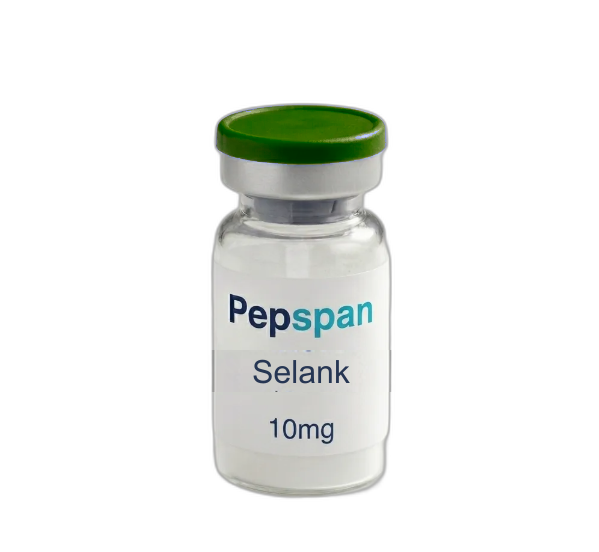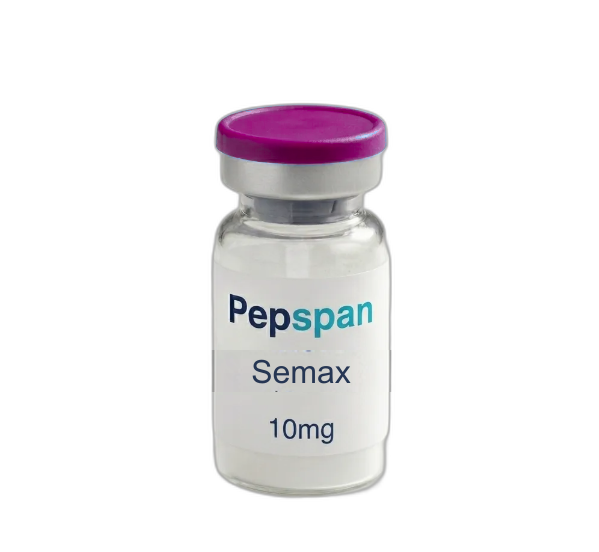
Semax Peptide 10mg
10mg per vial — Lyophilized Powder
Description
Semax at a glance. Semax 10 mg, a lyophilised powder for laboratory research use, costs €49.90 at Pepspan. Independent analysis of the current lot, PEP-SMX-2608-01, by Janoshik Analytical is scheduled; the report will be published on the lot page. Ships from Europe with EU delivery in 2–5 days; free shipping on orders over €50. Pay by card, PayPal or crypto (−15%).
Semax is a synthetic heptapeptide with the sequence Met-Glu-His-Phe-Pro-Gly-Pro, developed at the Institute of Molecular Genetics of the Russian Academy of Sciences. Its design combines the ACTH(4-7) fragment of adrenocorticotropic hormone with a C-terminal Pro-Gly-Pro extension added to protect the molecule from rapid enzymatic degradation. Importantly, published pharmacological characterization shows that Semax lacks the hormonal (corticotropic) activity of ACTH: it does not stimulate cortisol release, which makes it a precisely defined tool for studying the neurotropic actions of melanocortin-derived fragments in isolation.
The most extensively investigated mechanism in Semax research is its effect on neurotrophin expression. In rodent studies, Semax administration has been associated with increased expression of brain-derived neurotrophic factor (BDNF) and nerve growth factor (NGF) in the hippocampus and frontal cortex, together with elevated levels of the trkB receptor through which BDNF signals. Because BDNF is a central regulator of synaptic plasticity, neuronal survival, and learning-related remodeling, this mechanism underpins most of the cognitive and neuroprotective endpoints reported in the Semax literature.
Neuroprotection is the second major research axis. Semax was studied intensively in Russian models of cerebral ischemia, where treated animals showed reduced infarct volume, improved neurological scores, and attenuated oxidative and inflammatory markers compared with controls. Proposed contributing mechanisms include stabilization of neurotrophin signaling under hypoxic stress, modulation of nitric oxide synthesis, and effects on leukocyte adhesion in the ischemic penumbra. These findings led to clinical use of a nasal formulation in Russia; outside that jurisdiction, Semax remains strictly a research compound.
Behavioral research constitutes the third axis. In rodent models of attention, learning, and memory, Semax administration has been associated with improved performance in active avoidance, novel object recognition, and maze paradigms. Studies have also reported modulation of dopaminergic and serotonergic transmission, as well as inhibition of enkephalin-degrading enzymes, suggesting that the peptide's behavioral profile arises from an interplay of neurotrophic and neuromodulatory actions rather than a single receptor interaction.
Semax is supplied as a white lyophilized powder at 10mg per vial, exceeding 98% purity by HPLC analysis. The N-terminal methionine makes the molecule sensitive to oxidation, so proper storage — sealed, cold, and protected from light — is particularly relevant for this peptide.
EU Shipping: Ships from Spain to all 27 EU countries. Free shipping on orders over €50. No customs delays — intra-EU shipment. Tracked courier.
Reconstitution & Storage
Semax 10mg is supplied as a lyophilized powder; in the laboratory it is reconstituted with bacteriostatic water under aseptic conditions — swirl gently, do not shake. The heptapeptide dissolves readily.
- Expected appearance: Clear, colorless, particulate-free solution.
- Oxidation caution: The N-terminal methionine is oxidation-prone. Minimize headspace air in storage vials and avoid repeated septum punctures where possible.
- Post-reconstitution stability: Store at 2-8°C protected from light. Use within 30 days.
Stability & Half-Life Data
- Plasma half-life: Very short — on the order of minutes in rodent pharmacokinetic studies. The Pro-Gly-Pro extension slows but does not eliminate enzymatic cleavage; rapid tissue uptake and degradation dominate clearance.
- Biological activity duration: Despite the short plasma half-life, downstream effects on BDNF and NGF expression persist substantially longer (hours to days) — consistent with Semax acting as a signaling trigger for longer-lived transcriptional changes.
- Lyophilized stability: Up to 24 months at -20°C in a sealed vial protected from light and moisture. Up to 4 weeks at 2-8°C without measurable purity loss.
- Reconstituted stability: 30 days at 2-8°C when reconstituted with bacteriostatic water. The methionine residue makes prolonged storage of the working solution inadvisable.
- Thermal stability: The lyophilized form tolerates short transport excursions up to 40°C. The reconstituted peptide should remain refrigerated.
- Freeze-thaw: Avoid repeated freeze-thaw cycles of reconstituted solution. Aliquot before freezing if long-term storage is required.
- Light sensitivity: Moderate to high — both the methionine and the aromatic phenylalanine/histidine residues are photo-oxidation targets. Store reconstituted solution in amber vials or wrapped in foil.
Composition
- Peptide: Semax
- Sequence: Met-Glu-His-Phe-Pro-Gly-Pro (MEHFPGP)
- Molecular Formula: C37H51N9O10S
- Molecular Weight: 813.92 g/mol
- Purity: >98% (HPLC)
- Appearance: White lyophilized powder
- Quantity: 10mg per vial
Storage
- Store lyophilized peptide at -20C for long-term storage (up to 24 months).
- For short-term storage (up to 4 weeks), refrigerate at 2-8C.
- After reconstitution, store at 2-8C and use within 30 days.
- Avoid repeated freeze-thaw cycles.
- Protect from light and moisture at all times — the methionine residue is oxidation-sensitive.
Certificate of Analysis
Every batch of Semax sold by Pepspan undergoes rigorous third-party testing. Our Certificate of Analysis (COA) reports HPLC purity and the actual content per vial, measured by Janoshik Analytical on each lot. COA documentation is available upon request for any batch number. All testing is performed by independent European laboratories to ensure the highest standards of accuracy and reliability.
Batch Purity Report
Janoshik VerifiedCurrent batch: PEP-SMX-2608-01 · lot page →
Every batch of Semax sold by Pepspan is independently tested by Janoshik Analytical (Prague, Czech Republic). HPLC purity and the actual content per vial are measured for each shipment. Reports are batch-specific — not generic.
View All Purity Reports →Research Disclaimer
This product is intended for laboratory research use only. It is not a drug, food, cosmetic, or dietary supplement. Semax is not approved for human or veterinary use by any regulatory agency in the EU or US. It must not be administered to humans or animals outside of approved clinical trials. By purchasing this product, you confirm that you are a qualified researcher and that this product will be used exclusively for legitimate scientific research purposes. Pepspan assumes no liability for any misuse of this product. All handling must comply with local regulations and institutional safety protocols.
Frequently Asked Questions
What is Semax?
Semax is a synthetic heptapeptide with the sequence Met-Glu-His-Phe-Pro-Gly-Pro, developed at the Institute of Molecular Genetics of the Russian Academy of Sciences. It combines the ACTH(4-7) fragment of adrenocorticotropic hormone with a C-terminal Pro-Gly-Pro extension that increases enzymatic stability. Unlike ACTH, Semax shows no corticotropic (hormonal) activity in published studies and is investigated for neuroprotection, BDNF expression, and cognitive research.
How is Semax reconstituted?
Semax 10mg is supplied lyophilised; in the laboratory it is reconstituted with bacteriostatic water under aseptic conditions — swirl gently, do not shake. The solution should be clear and colorless.
What research areas cite Semax in the literature?
Published research on Semax spans neuroprotection in cerebral ischemia models, upregulation of BDNF and NGF expression in the hippocampus and cortex, modulation of dopaminergic and serotonergic signaling, and attention and memory endpoints in rodent behavioral models. Researchers should consult the primary literature for the concentrations and models reported in each study.
How long does Semax last after reconstitution?
Reconstituted Semax stored at 2-8°C should be used within 30 days. The N-terminal methionine residue is oxidation-sensitive, so minimizing headspace air, protecting from light, and avoiding freeze-thaw cycles of the working solution are recommended.
Can I buy Semax in Europe?
Yes. Pepspan ships Semax 10mg lyophilized vials across all 27 EU countries from Spain. Each batch is independently tested by Janoshik Analytical (Prague) for HPLC purity and content per vial. COA included. Research Use Only. Orders ship from Europe — no customs delays, intra-EU shipment.
Do I need a prescription for Semax?
Pepspan does not sell medicines and does not dispense against prescriptions. Semax is supplied exclusively as a reference material for laboratory research, not for human or veterinary use. Check the regulations in your country before ordering.
How does Semax compare to Selank?
Semax (Met-Glu-His-Phe-Pro-Gly-Pro, ~814 Da) is derived from ACTH(4-7) and is studied mainly for neuroprotective and cognitive endpoints via BDNF/NGF expression. Selank (Thr-Lys-Pro-Arg-Pro-Gly-Pro, ~752 Da) is derived from the immune tetrapeptide tuftsin and is studied mainly for anxiolytic endpoints via GABAergic modulation. They share the stabilizing Pro-Gly-Pro extension and are often studied as complementary tools in neuropeptide research.
Is Semax tested by Janoshik?
Yes. Every batch of Pepspan Semax is independently tested by Janoshik Analytical (Prague). The Certificate of Analysis covers HPLC purity and the actual content per vial. COA is batch-specific and available on request.
Where can I buy Semax online in Europe?
Semax 10mg (lyophilized vial) is for sale online at Pepspan for €49.90, shipped from our stock in Spain. The independent analysis of the current lot PEP-SMX-2608-01 is scheduled at Janoshik Analytical (Prague): the sample goes to the laboratory in the week of 28 September 2026, and the lot page /l/SMX2608 will show the certificate as soon as it is issued. Orders leave Spain within 24–48 h with tracking; delivery in the EU usually takes 2–5 business days. Free EU shipping on orders over €50; GB, CH, NO, IS and LI ship at a flat €19.90; UK orders usually arrive 2–3 business days after dispatch (UPS, tracked). Pay by PayPal, bank transfer or crypto. Research use only.
Further Research Resources
Additional research articles, comparison guides, and laboratory protocols related to this peptide:
Related Products