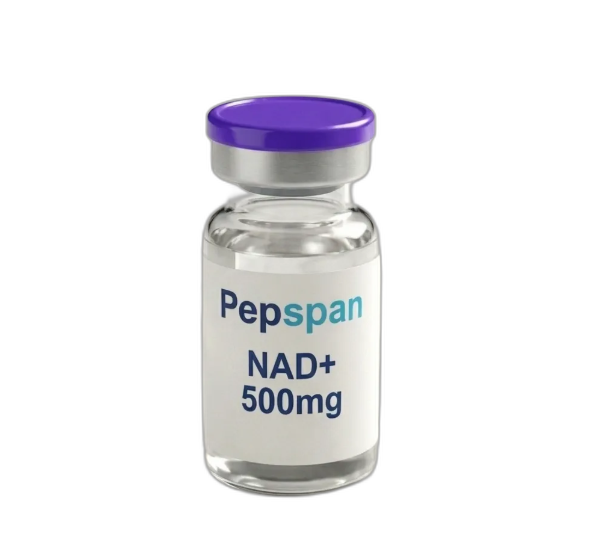
NAD+ 500mg Lyophilized Vial
500mg per vial — Lyophilized Powder
Description
NAD+ at a glance. NAD+ 500 mg is currently out of stock at Pepspan (€64.90 when available). Leave your email on this page to be notified as soon as it is back. Independent analysis of the current lot, PEP-NADP-2608-01, by Janoshik Analytical is scheduled; the report will be published on the lot page.
Nicotinamide Adenine Dinucleotide (NAD+) is a coenzyme found in all living cells that plays a central role in cellular metabolism, energy production, and DNA repair. As one of the most fundamental molecules in biochemistry, NAD+ participates in over 500 enzymatic reactions, serving as a critical electron carrier in the mitochondrial electron transport chain and as a substrate for key regulatory enzymes including sirtuins, PARPs (poly-ADP-ribose polymerases), and CD38.
Research into NAD+ biology has accelerated dramatically following the discovery that NAD+ levels decline significantly with age. Studies in multiple model organisms have demonstrated that this age-related NAD+ decline correlates with mitochondrial dysfunction, impaired DNA repair capacity, and the onset of numerous age-associated pathologies. In landmark studies by Sinclair and colleagues at Harvard Medical School, restoration of NAD+ levels in aged mice through precursor supplementation resulted in dramatic improvements in mitochondrial function, with aged tissue resembling that of much younger animals within one week of treatment.
The sirtuin pathway represents one of the most intensively studied NAD+-dependent signaling cascades. Sirtuins (SIRT1-7) are NAD+-dependent deacylases that regulate numerous cellular processes including gene expression, stress response, metabolism, and circadian rhythms. SIRT1 and SIRT3 in particular have been identified as key mediators of the beneficial effects of caloric restriction, the only intervention consistently shown to extend lifespan across species. By maintaining adequate NAD+ pools, sirtuin activity is sustained, supporting cellular homeostasis and stress resilience.
PARP enzymes represent another critical NAD+-dependent system. PARPs consume NAD+ during DNA repair processes, and chronic DNA damage — which accumulates with age — progressively depletes cellular NAD+ reserves. This creates a vicious cycle where declining NAD+ impairs both PARP-mediated DNA repair and sirtuin-mediated protective gene regulation. Research has shown that NAD+ repletion can break this cycle, restoring DNA repair capacity and reducing accumulated DNA damage in aged tissues.
NAD+ has also been investigated in the context of neurodegeneration, cardiovascular function, and immune regulation. In preclinical studies, NAD+ augmentation protected against axonal degeneration, improved cardiac function in models of heart failure, and enhanced the function of aged immune cells. Multiple clinical trials are currently underway investigating NAD+ precursors for conditions ranging from age-related cognitive decline to metabolic syndrome. This product is supplied as a lyophilized powder at 500mg per vial, exceeding 98% purity by HPLC analysis.
EU Shipping: Ships from the EU warehouse. Free shipping on orders over €50. No customs delays — intra-EU shipment. Tracked via Spring GDS / DHL EU Connect. Janoshik COA available per batch on request.
Reconstitution & Storage
NAD+ 500mg is supplied as a lyophilised powder. Unlike most peptides on this site, in the laboratory it is reconstituted with sterile, preservative-free water rather than bacteriostatic water — benzyl alcohol can accelerate NAD+ degradation. Reconstitution is carried out under aseptic conditions: swirl gently, do not shake.
- Expected appearance: Clear, colorless to pale yellow solution with no particulates. Slight yellow tinge is normal and does not indicate degradation.
- Post-reconstitution stability: Store at 2-8°C protected from light. Use within 14 days; discard if solution turns deeply yellow, brown, or develops particulates.
Stability & Half-Life Data
- Plasma half-life: Approximately 10 minutes in rodent pharmacokinetic studies following systemic administration. Rapid clearance reflects continuous consumption by NAD+-dependent enzymes (PARPs, sirtuins, CD38) and ongoing turnover via salvage and de novo synthesis pathways.
- Tissue-level persistence: Despite the short plasma half-life, cellular NAD+ pool size is the relevant research endpoint — pool size reflects net synthesis-versus-consumption balance and can remain elevated for hours after a single dose, or sustained for days with infusion or repeated dosing protocols.
- Lyophilized stability: In a sealed vial protected from light and moisture, the lyophilized powder is stable at room temperature during transit and tolerates short transport excursions. For long-term storage, refrigerate at 2-8°C.
- Reconstituted stability: 14 days at 2-8°C in low-protein-binding polypropylene containers, protected from light. NAD+ is particularly photosensitive — UV exposure cleaves the pyridine-ribose bond.
- Photodegradation: NAD+ is highly sensitive to UV and visible light. Always store and handle reconstituted solution in amber vials or under low-light conditions.
- Thermal stability: Lyophilized form is stable at 4°C for transport but rapidly degrades above 25°C. Avoid all sustained temperature excursions.
- Freeze-thaw: Avoid repeated freeze-thaw cycles of reconstituted solution. Aliquot into single-use volumes before freezing if long-term storage is required.
- Incompatibilities: Avoid acidic or strongly basic solutions — NAD+ hydrolyzes outside the pH range 6.5-8.0. Avoid prolonged contact with benzyl alcohol preservatives.
Composition
- Compound: NAD+ (Nicotinamide Adenine Dinucleotide)
- Molecular Formula: C21H27N7O14P2
- Molecular Weight: 663.43 g/mol
- CAS Number: 53-84-9
- Purity: >98% (HPLC)
- Appearance: Lyophilized powder
- Quantity: 500mg per vial
Storage
- Store the sealed lyophilized vial in a cool, dry place, protected from light.
- For long-term storage, refrigerate at 2-8°C.
- After reconstitution, store at 2-8°C and use within 14 days.
- NAD+ is sensitive to light and heat — protect from both at all times.
- Avoid repeated freeze-thaw cycles.
Certificate of Analysis
Every batch of NAD+ sold by Pepspan undergoes rigorous third-party testing. Our Certificate of Analysis (COA) reports HPLC purity and the actual content per vial, measured by Janoshik Analytical on each lot. COA documentation is available upon request for any batch number. All testing is performed by independent European laboratories.
Batch Purity Report
Janoshik VerifiedCurrent batch: PEP-NADP-2608-01 · lot page →
Every batch of NAD+ 500mg sold by Pepspan is independently tested by Janoshik Analytical (Prague, Czech Republic). HPLC purity and the actual content per vial are measured for each shipment. Reports are batch-specific — not generic.
View All Purity Reports →Research Disclaimer
This product is intended for laboratory research use only. It is not a drug, food, cosmetic, or dietary supplement. NAD+ is not approved for human or veterinary use by any regulatory agency. It must not be administered to humans or animals outside of approved clinical trials. By purchasing this product, you confirm that you are a qualified researcher and that this product will be used exclusively for legitimate scientific research purposes. Pepspan assumes no liability for any misuse of this product.
Frequently Asked Questions
What is NAD+?
NAD+ (Nicotinamide Adenine Dinucleotide) is a coenzyme found in all living cells that serves as a critical electron carrier in the mitochondrial electron transport chain and as a substrate for sirtuins (SIRT1-7), PARPs, and CD38. NAD+ levels decline significantly with age in mammals, and research has linked this decline to mitochondrial dysfunction, impaired DNA repair, and a wide range of age-associated phenotypes.
How is NAD+ reconstituted?
NAD+ 500mg is supplied as a lyophilised powder. Unlike most peptides on this site, in the laboratory it is reconstituted with sterile, preservative-free water rather than bacteriostatic water — NAD+ is sensitive to benzyl alcohol over extended timeframes. Reconstitution is carried out under aseptic conditions: swirl gently until fully dissolved, do not shake. The solution should be clear and colorless to pale yellow. Protect from light immediately after reconstitution.
What concentrations are cited in the research literature?
Published NAD+ repletion studies have used a range of concentrations in rodent and larger model organisms depending on the experimental endpoint. Consult Sinclair et al. and Imai et al. for the concentrations reported in each study. Sublingual or oral routes have much lower bioavailability and are addressed by precursor compounds (NMN, NR) rather than NAD+ directly.
How should NAD+ be stored?
Store the sealed lyophilized vial in a cool, dry place, protected from light. The lyophilized powder is stable at room temperature during transit and does not require a cold chain; for long-term storage, refrigeration at 2-8°C is the most conservative option. After reconstitution, refrigerate at 2-8°C protected from light and use within 14 days; discard the solution if it turns brown or develops particulates. NAD+ is sensitive to light and heat — protect from both at all times. Avoid repeated freeze-thaw cycles.
Is NAD+ legal in the EU?
Pepspan supplies NAD+ exclusively as a reference material for laboratory research, not for human or veterinary use, and it is not an authorised medicine. Rules on buying and handling research compounds differ between countries and can change: check the rules that apply to you before ordering. Pepspan ships to all 27 EU countries from Spain.
What is the half-life of NAD+?
Plasma half-life of exogenously administered NAD+ is approximately 10 minutes in rodent pharmacokinetic studies, reflecting rapid uptake, ongoing metabolism, and continuous turnover by NAD+-consuming enzymes (PARPs, sirtuins, CD38). However, the relevant variable for research is cellular NAD+ pool size, which reflects net synthesis-versus-consumption balance and persists much longer than the plasma window. This is why infusion or repeated dosing protocols are commonly used to maintain elevated cellular NAD+ in research models.
Is a Certificate of Analysis available?
Yes. Every batch of NAD+ is independently tested by Janoshik Analytical (Prague, Czech Republic). The Certificate of Analysis covers HPLC purity and the actual content per vial. COA is batch-specific and available on request.
What's the difference vs NAD+ Sublingual?
The injectable NAD+ 500mg vial is intended for parenteral research models (subcutaneous or intravenous administration), achieving high plasma and tissue NAD+ levels directly. NAD+ Sublingual is formulated for transmucosal absorption via the sublingual route, bypassing first-pass gastrointestinal metabolism that would otherwise destroy the molecule. Sublingual delivery achieves much lower peak plasma levels but supports chronic research protocols where convenience matters more than peak NAD+ concentration.
Where can I buy NAD+ 500mg online in Europe?
NAD+ 500mg (lyophilized vial) is for sale online at Pepspan for €64.90, shipped from our stock in Spain. The independent analysis of the current lot PEP-NADP-2608-01 at Janoshik Analytical (Prague) is scheduled; the lot page /l/NADP2608 shows its status and will show the certificate as soon as it is issued. Orders leave Spain within 24–48 h with tracking; delivery in the EU usually takes 2–5 business days. Free EU shipping on orders over €50; GB, CH, NO, IS and LI ship at a flat €19.90; UK orders usually arrive 2–3 business days after dispatch (UPS, tracked). Pay by PayPal, bank transfer or crypto. Research use only.
Further Research Resources
Additional research articles, comparison guides, and laboratory protocols related to this peptide:
Related Products