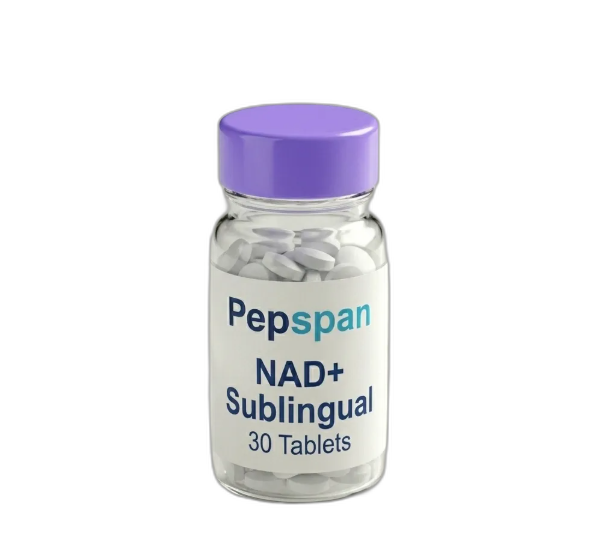
NAD+ Sublingual
30 Tablets — 250mg per tablet
Description
NAD+ Sublingual tablets represent an alternative delivery format for Nicotinamide Adenine Dinucleotide research, designed for absorption through the sublingual mucosa. The sublingual route bypasses first-pass hepatic metabolism, which is a significant consideration for NAD+ delivery since oral ingestion subjects the molecule to extensive gastrointestinal degradation. Research has demonstrated that sublingual absorption of nucleotide-based compounds can achieve higher bioavailability compared to standard oral administration.
Each tablet contains 250mg of NAD+ in a formulation optimized for sublingual dissolution. The sublingual mucosa is highly vascularized and permeable, allowing direct absorption into the systemic circulation. Pharmacokinetic studies of sublingual NAD+ delivery have shown measurable increases in plasma NAD+ metabolites within 30 minutes of administration, compared to 1-2 hours for oral formulations with generally lower peak levels.
The non-invasive nature of sublingual delivery makes this format particularly valuable for longitudinal research protocols where repeated administration is required. Unlike vial formulations that require reconstitution, sterile technique, and cold chain management, sublingual tablets can be stored at room temperature and administered without specialized equipment. This simplifies experimental design and reduces variables related to injection technique and reconstitution protocols.
Research applications for sublingual NAD+ mirror those of the vial form: cellular energy metabolism, sirtuin activation, DNA repair capacity, and age-related decline in NAD+ pools. The sublingual format is particularly suited for research comparing bioavailability across delivery routes, studying dose-response relationships in accessible models, and protocols requiring frequent or chronic administration. Each tablet is manufactured under cGMP conditions with consistent dosing across the batch.
Quality control for NAD+ sublingual tablets includes HPLC purity analysis of the active compound, dissolution testing to verify appropriate release kinetics, content uniformity testing across the batch, and stability testing under various storage conditions. This product is supplied as 30 tablets per bottle, each containing 250mg NAD+.
EU Shipping: Ships from EU warehouse in 24-48h. Free shipping on orders over €100. No customs delays — intra-EU shipment. Tracked via Spring GDS / DHL EU Connect. Janoshik COA available per batch on request.
Administration Protocol
NAD+ Sublingual is supplied as a ready-to-use tablet — no reconstitution or diluent is required. Standard laboratory administration protocols are summarized below — researchers should validate against their own internal SOPs.
- Format: Sublingual tablet (250mg NAD+ per tablet, 30 tablets per bottle).
- Diluent: None required. Excipient base (mannitol, cellulose, magnesium stearate) provides controlled dissolution kinetics.
- Administration route: Place tablet under the tongue. Allow to dissolve completely (1-3 minutes). Do NOT chew or swallow whole — both routes bypass the sublingual mucosa and direct the NAD+ into gastrointestinal degradation.
- Post-administration window: Avoid food, drink, and oral rinsing for 15 minutes after dissolution to maximize transmucosal absorption.
- Expected dissolution time: 60-180 seconds for complete tablet dissolution under physiological mucosal conditions.
- Typical research dosing window: 25-250 mg per administration (1 tablet = 250mg); commonly 1-2 administrations per 24h cycle in chronic research protocols. Higher daily total exposures (500-1000 mg) may be used in dose-response research designs by administering 2-4 tablets sequentially.
- Onset of plasma NAD+ metabolite increase: Approximately 30 minutes from administration — faster than oral NAD+ (1-2 hours) but slower than parenteral routes (immediate).
- Storage during research protocol: Keep bottle tightly sealed between uses to prevent humidity exposure. Room temperature is acceptable for the entire research timeline.
Stability & Half-Life Data
- Plasma half-life of absorbed NAD+: Approximately 10 minutes once in systemic circulation — identical to the half-life of NAD+ delivered via other routes. Continuous metabolism by NAD+-consuming enzymes (PARPs, sirtuins, CD38) governs plasma clearance.
- Absorption window (sublingual): Plasma NAD+ metabolite levels begin to rise approximately 30 minutes after administration and peak within 60-90 minutes — significantly faster than oral NAD+ delivery, where gastrointestinal degradation delays and reduces systemic exposure.
- Tablet shelf life: 18 months from date of manufacture when stored sealed at room temperature (15-25°C). The lyoprotected solid-state formulation is significantly more stable than reconstituted NAD+ in solution.
- Once-opened stability: Use within the 18-month shelf-life window with the bottle tightly resealed between uses. Avoid humidity exposure — moisture accelerates hydrolytic degradation of the pyridine-ribose bond.
- Thermal stability: Stable at room temperature up to 25°C. Do not expose to sustained temperatures above 30°C or to freezing conditions (which can stress excipient binding and affect dissolution).
- Photodegradation: Store away from direct sunlight. UV exposure degrades the active NAD+ component over extended periods.
- Incompatibilities: Avoid co-administration with acidic foods or beverages immediately post-dose — the acidic environment can accelerate NAD+ hydrolysis before mucosal absorption completes.
Composition
- Compound: NAD+ (Nicotinamide Adenine Dinucleotide)
- Format: Sublingual tablets
- Dosage: 250mg per tablet
- Quantity: 30 tablets per bottle
- Total NAD+: 7,500mg per bottle
- Purity: >98% (HPLC)
- Excipients: Mannitol, cellulose, magnesium stearate
Storage
- Store in a cool, dry place away from direct sunlight.
- Keep at room temperature (15-25°C) — no refrigeration required.
- Keep bottle tightly sealed between uses.
- Shelf life: 18 months from date of manufacture.
- Do not expose to excessive humidity or heat.
Certificate of Analysis
Every batch of NAD+ Sublingual tablets sold by Pepspan undergoes rigorous third-party testing. Our Certificate of Analysis (COA) includes HPLC purity analysis, dissolution testing, content uniformity, and microbiological testing. COA documentation is available upon request for any batch number.
Batch Purity Report
Janoshik VerifiedCurrent Batch: Pending first shipment
Every batch of NAD+ Sublingual sold by Pepspan is independently tested by Janoshik Analytical (Prague, Czech Republic). HPLC purity analysis, mass spectrometry, and amino acid sequencing are performed for each shipment. Reports are batch-specific — not generic.
View All Purity Reports →Research Disclaimer
This product is intended for laboratory research use only. It is not a drug, food, cosmetic, or dietary supplement. NAD+ Sublingual tablets are not approved for human or veterinary use by any regulatory agency. By purchasing this product, you confirm that you are a qualified researcher and that this product will be used exclusively for legitimate scientific research purposes.
Frequently Asked Questions
What is NAD+ Sublingual?
NAD+ Sublingual is a tablet formulation of Nicotinamide Adenine Dinucleotide (NAD+) designed for absorption through the sublingual mucosa. Each tablet contains 250mg of NAD+ and bypasses first-pass gastrointestinal metabolism, which would otherwise destroy the molecule before absorption. The sublingual route delivers NAD+ directly into the systemic circulation via the highly vascularized oral mucosa.
How is NAD+ Sublingual administered?
NAD+ Sublingual is administered as a tablet placed under the tongue and allowed to dissolve over 1-3 minutes without chewing or swallowing. No reconstitution is required — the tablet is supplied ready-to-use. Avoid food, drink, or rinsing for 15 minutes after administration to maximize mucosal absorption. Each tablet contains 250mg NAD+.
What is the typical research dosage?
Sublingual NAD+ research protocols typically use 25-250 mg per day, often divided into 1-2 administrations. Sublingual bioavailability is significantly lower than injectable NAD+, so per-dose magnitudes are calibrated to the experimental endpoint (cellular NAD+ pool elevation vs single-dose pharmacokinetics). Research dose ranges commonly target 100-500 mg total daily exposure across multiple tablets when chronic NAD+ pool elevation is the objective.
How should NAD+ Sublingual be stored?
Store NAD+ Sublingual tablets in a cool, dry place away from direct sunlight. Room temperature (15-25°C) is acceptable — no refrigeration required. Keep the bottle tightly sealed between uses to prevent humidity exposure. Shelf life is 18 months from the date of manufacture. Do not expose to excessive humidity or heat. Unlike injectable NAD+, the tablet formulation has stabilizing excipients that preserve potency at room temperature.
Is NAD+ Sublingual legal in the EU?
Yes, when sold strictly as a research reference material for laboratory and in vitro use. NAD+ is a naturally occurring coenzyme and is not a pharmaceutical, dietary supplement, or cosmetic when sold for research purposes only. Pepspan ships to all 27 EU countries from Spain — intra-EU shipment, no customs delays.
What is the bioavailability of sublingual NAD+?
Sublingual delivery achieves measurable plasma NAD+ metabolite increases within approximately 30 minutes of administration, compared to 1-2 hours for oral formulations. The peak plasma level is substantially lower than injectable administration, but sublingual delivery bypasses the gastrointestinal degradation that destroys orally administered NAD+. Once absorbed, the systemic NAD+ has the same approximately 10-minute plasma half-life as the injectable form, with the cellular NAD+ pool being the relevant tissue-level research endpoint.
Is a Certificate of Analysis available?
Yes. Every batch of NAD+ Sublingual is independently tested by Janoshik Analytical (Prague, Czech Republic). The Certificate of Analysis covers HPLC purity (>98%) of the NAD+ active, dissolution testing, content uniformity across the batch, and microbiological testing. COA is batch-specific and available on request.
What's the difference vs injectable NAD+?
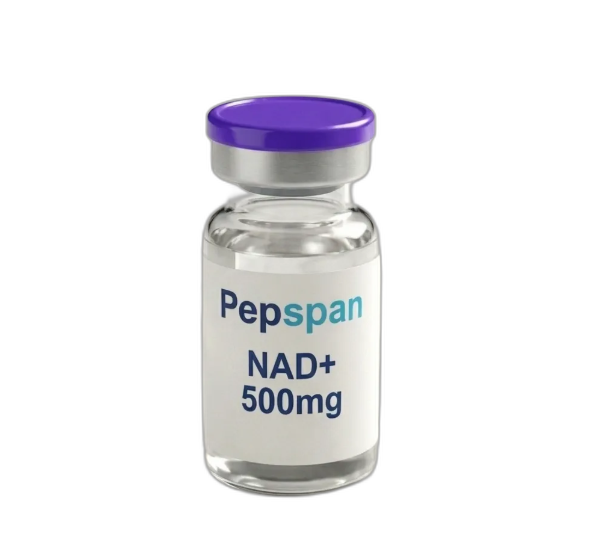
Injectable NAD+ (500mg lyophilized vial) requires reconstitution with sterile water and is administered via subcutaneous or intravenous routes, achieving high peak plasma and tissue NAD+ levels — best for research models requiring acute or sustained-infusion NAD+ elevation. NAD+ Sublingual is a ready-to-use tablet for transmucosal absorption — best for chronic research protocols requiring frequent dosing without injection, where convenience and lower-but-repeated NAD+ exposure align with the experimental endpoint.
Further Research Resources
Additional research articles, comparison guides, and laboratory protocols related to this peptide: