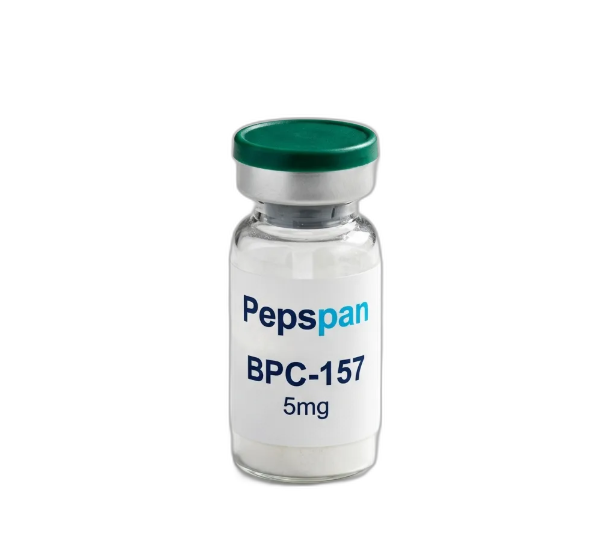
BPC-157 Peptide 5mg
5mg per vial — Lyophilized Powder
Description
BPC-157 at a glance. BPC-157 5 mg, a lyophilised powder for laboratory research use, costs €49.90 at Pepspan. The current lot, PEP-BPC157-2607-01, was tested by Janoshik Analytical at 99.7% HPLC purity — verify the report. Ships from Europe with EU delivery in 2–5 days; free shipping on orders over €50. Pay by card, PayPal or crypto (−15%).
BPC-157, also known as Body Protection Compound-157, is a synthetic pentadecapeptide derived from a protective protein found in human gastric juice. The peptide consists of fifteen amino acids and is classified as a stable gastric pentadecapeptide due to its remarkable resistance to enzymatic degradation in the gastrointestinal tract. This stability sets it apart from many other peptides used in laboratory research, making it a highly practical candidate for a wide range of experimental protocols.
In preclinical research models, BPC-157 has demonstrated significant activity related to tissue repair and regeneration. Studies conducted on rodent models have shown that BPC-157 accelerates the healing of various soft tissue injuries, including tendons, ligaments, muscles, and skin. One of the most extensively studied mechanisms involves its effect on angiogenesis, the formation of new blood vessels, which is a critical component of tissue repair. Research published in peer-reviewed journals has documented BPC-157's capacity to upregulate the expression of vascular endothelial growth factor (VEGF) receptors and promote endothelial cell migration in vitro.
The peptide has also been investigated for its gastroprotective properties. In experimental ulcer models, BPC-157 has shown the ability to counteract lesions induced by various agents, including alcohol, NSAIDs, and stress protocols. Researchers have observed that BPC-157 interacts with the nitric oxide (NO) system, the dopamine system, and the prostaglandin pathway, suggesting a multi-targeted mechanism of action that goes beyond simple wound closure.
Additional areas of active investigation include the peptide's potential effects on bone healing, where studies have reported accelerated fracture consolidation in animal models. Neurological research has explored BPC-157's interaction with the central nervous system, including its effects on serotonergic and GABAergic pathways. Some preclinical data suggest neuroprotective activity in models of traumatic brain injury and peripheral nerve damage.
BPC-157 is supplied as a white to off-white lyophilized powder with a purity exceeding 98% as verified by HPLC analysis. Each vial contains 5mg of peptide and should be reconstituted with bacteriostatic water prior to use in research applications. The peptide sequence is Gly-Glu-Pro-Pro-Pro-Gly-Lys-Pro-Ala-Asp-Asp-Ala-Gly-Leu-Val.
EU Shipping: Ships from Spain to all 27 EU countries. Free shipping on orders over €50. No customs delays — intra-EU shipment. Tracked courier.
Reconstitution & Storage
BPC-157 5mg is supplied as a lyophilized powder; in the laboratory it is reconstituted with bacteriostatic water under aseptic conditions — swirl gently, do not shake.
- Expected appearance: Clear, colorless, particulate-free solution. If cloudiness persists, allow the vial to sit at room temperature for a few minutes and swirl gently again.
- Post-reconstitution stability: Store at 2-8°C protected from light. Use within 30 days. Avoid repeated freeze-thaw of the working solution.
Stability & Half-Life Data
- Plasma half-life: Approximately 30 minutes after intraperitoneal administration in rodent pharmacokinetic studies. Despite the short plasma half-life, downstream biological effects in tissue persist substantially longer, consistent with a signaling cascade rather than direct dose-response activity.
- Gastric stability: BPC-157 demonstrates exceptional resistance to gastric acid degradation. Studies using simulated gastric fluid have shown structural integrity preserved at pH levels as low as 1.5, attributed to its proline-rich sequence resistant to pepsin cleavage.
- Lyophilized stability: Up to 24 months at -20°C in a sealed vial protected from light and moisture. Up to 4 weeks at 2-8°C without measurable purity loss.
- Reconstituted stability: 30 days at 2-8°C when reconstituted with bacteriostatic water. Beyond 30 days, gradual peptide degradation may occur.
- Thermal stability: The lyophilized form is stable up to 40°C for short transport excursions. The reconstituted peptide should be kept refrigerated at all times.
- Freeze-thaw: Avoid repeated freeze-thaw cycles of the reconstituted solution. Aliquot into single-use volumes before freezing if extended storage is required.
- Light sensitivity: Moderate. Store reconstituted solution in amber vials or wrapped in foil. Avoid sustained direct UV or strong visible light.
Composition
- Peptide: BPC-157 (Body Protection Compound-157)
- Sequence: Gly-Glu-Pro-Pro-Pro-Gly-Lys-Pro-Ala-Asp-Asp-Ala-Gly-Leu-Val
- Molecular Formula: C62H98N16O22
- Molecular Weight: 1419.53 g/mol
- Purity: >98% (HPLC)
- Appearance: White to off-white lyophilized powder
- Quantity: 5mg per vial
Storage
- Store lyophilized peptide at -20C for long-term storage (up to 24 months).
- For short-term storage (up to 4 weeks), refrigerate at 2-8C.
- After reconstitution, store at 2-8C and use within 30 days.
- Avoid repeated freeze-thaw cycles.
- Protect from light and moisture at all times.
Certificate of Analysis
Every batch of BPC-157 sold by Pepspan undergoes rigorous third-party testing. Our Certificate of Analysis (COA) reports HPLC purity and the actual content per vial, measured by Janoshik Analytical on each lot. COA documentation is available upon request for any batch number. All testing is performed by independent European laboratories to ensure the highest standards of accuracy and reliability.
Batch Purity Report
Janoshik VerifiedCurrent batch: PEP-BPC157-2607-01 · lot page →
Every batch of BPC-157 sold by Pepspan is independently tested by Janoshik Analytical (Prague, Czech Republic). HPLC purity and the actual content per vial are measured for each shipment. Reports are batch-specific — not generic.
View All Purity Reports →Research Disclaimer
This product is intended for laboratory research use only. It is not a drug, food, cosmetic, or dietary supplement. BPC-157 is not approved for human or veterinary use by any regulatory agency. It must not be administered to humans or animals outside of approved clinical trials. By purchasing this product, you confirm that you are a qualified researcher and that this product will be used exclusively for legitimate scientific research purposes. Pepspan assumes no liability for any misuse of this product. All handling must comply with local regulations and institutional safety protocols.
Frequently Asked Questions
What is BPC-157?
BPC-157 (Body Protection Compound-157) is a synthetic pentadecapeptide derived from a protective protein found in human gastric juice. It consists of 15 amino acids (Gly-Glu-Pro-Pro-Pro-Gly-Lys-Pro-Ala-Asp-Asp-Ala-Gly-Leu-Val) and is widely studied in preclinical models for tissue repair, angiogenesis, gastroprotection, and tendon/ligament healing.
How is BPC-157 reconstituted?
BPC-157 5mg is supplied lyophilised; in the laboratory it is reconstituted with bacteriostatic water under aseptic conditions — swirl gently, do not shake. The solution should be clear and colorless.
What concentrations are cited in the research literature for BPC-157?
Published rodent studies have used BPC-157 across a wide concentration range depending on the experimental endpoint; reported values in rat tendon and ligament studies vary by study and endpoint. Researchers should consult primary literature (Sikiric et al., 2010-2020) for the concentrations reported in each study.
How long does BPC-157 last after reconstitution?
Reconstituted BPC-157 stored at 2-8°C is stable for up to 30 days. The peptide's intrinsic gastric stability and proline-rich sequence make it more resistant to enzymatic degradation than most peptides, but standard refrigerated storage is still required. Protect from light. Avoid freeze-thaw cycles of the working solution.
Can I buy BPC-157 in Europe?
Yes. Pepspan ships BPC-157 5mg lyophilized vials across all 27 EU countries from Spain. Each batch is independently tested by Janoshik Analytical (Prague). COA included. Research Use Only. Orders ship with no customs delays — intra-EU shipment.
Do I need a prescription for BPC-157?
Pepspan does not sell medicines and does not dispense against prescriptions. BPC-157 is supplied exclusively as a reference material for laboratory research, not for human or veterinary use. Check the regulations in your country before ordering.
How does BPC-157 compare to TB-500?
BPC-157 and TB-500 are both studied for tissue repair but act via different mechanisms. BPC-157 (15 amino acids, ~1,419 Da) modulates the nitric oxide system, prostaglandins, and growth factor signaling, with particular relevance to tendon, ligament, and GI tissue. TB-500 (~5,000 Da) is a Thymosin Beta-4 fragment that regulates actin dynamics and is studied for cardiac, muscle, and dermal repair. The Wolverine Blend combines both for synergistic research.
Is BPC-157 tested by Janoshik?
Yes. Every batch of Pepspan BPC-157 is independently tested by Janoshik Analytical (Prague). The Certificate of Analysis covers HPLC purity and the actual content per vial. COA is batch-specific and available on request.
Where can I buy BPC-157 online in Europe?
BPC-157 5mg is for sale online at Pepspan for €49.90 per vial, shipped from our stock in Spain. The current lot PEP-BPC157-2607-01 was tested by Janoshik Analytical (Prague): 99.7% HPLC purity; the certificate is on /l/BPC1572607. Orders leave Spain within 24–48 h with tracking; delivery in the EU usually takes 2–5 business days. Free EU shipping on orders over €50; GB, CH, NO, IS and LI ship at a flat €19.90; UK orders usually arrive 2–3 business days after dispatch (UPS, tracked). Pay by PayPal, bank transfer or crypto. Research use only.
Further Research Resources
Additional research articles, comparison guides, and laboratory protocols related to this peptide:
Related Products
 BEST VALUE