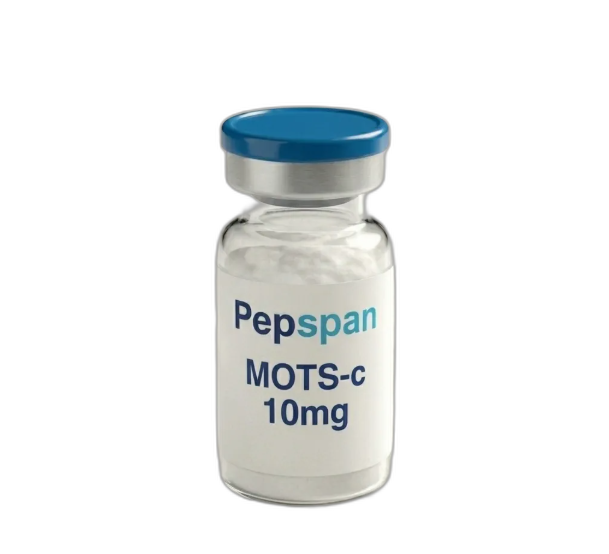
MOTS-c Peptide 10mg
10mg per vial — Lyophilized Powder
Description
MOTS-c at a glance. MOTS-c 10 mg, a lyophilised powder for laboratory research use, costs €74.90 at Pepspan. Independent analysis of the current lot, PEP-MOTSC-2608-01, by Janoshik Analytical is scheduled; the report will be published on the lot page. Ships from Europe with EU delivery in 2–5 days; free shipping on orders over €50. Pay by card, PayPal or crypto (−15%).
MOTS-c (Mitochondrial Open Reading Frame of the Twelve S rRNA type-c) is a mitochondrial-derived peptide (MDP) consisting of 16 amino acids encoded within the mitochondrial genome. First identified in 2015 by Dr. Changhan David Lee and colleagues at the University of Southern California, MOTS-c represents a groundbreaking discovery in mitochondrial biology — demonstrating that mitochondria produce signaling peptides that regulate nuclear gene expression, a phenomenon termed "retrograde signaling" or mitonuclear communication.
The primary mechanism of MOTS-c action involves activation of the AMPK (AMP-activated protein kinase) pathway, the master cellular energy sensor. In landmark studies published in Cell Metabolism, MOTS-c was shown to activate AMPK signaling in skeletal muscle, enhancing glucose uptake and fatty acid oxidation independently of insulin. Treatment with MOTS-c prevented diet-induced obesity in mice, improved glucose tolerance, and increased insulin sensitivity. Remarkably, these metabolic effects were observed both with systemic administration and with direct treatment of muscle cells in culture.
Research into MOTS-c and exercise biology has produced particularly compelling findings. Circulating MOTS-c levels increase significantly during exercise in humans, and MOTS-c has been shown to translocate to the nucleus in response to metabolic stress, where it directly regulates the expression of genes involved in glucose metabolism and antioxidant defense. In aged mice, MOTS-c treatment improved physical performance on treadmill tests, enhanced exercise capacity, and reduced markers of cellular senescence in skeletal muscle.
The longevity implications of MOTS-c are supported by population genetics data. Studies have identified a specific MOTS-c variant (m.1382A>C, K14Q) that is significantly enriched in Japanese centenarians compared to the general population. This variant appears to enhance MOTS-c signaling activity, suggesting that naturally elevated MOTS-c function may contribute to exceptional longevity. Additional research has shown that circulating MOTS-c levels decline with age in humans, paralleling the age-related decline in mitochondrial function.
Beyond metabolic regulation, MOTS-c has demonstrated cytoprotective properties in models of oxidative stress, inflammation, and cellular senescence. The peptide has been shown to reduce inflammatory cytokine production, protect against endothelial dysfunction, and improve bone density in osteoporosis models. MOTS-c is supplied as a white lyophilized powder at 10mg per vial, exceeding 98% purity by HPLC analysis.
EU Shipping: Ships from the EU warehouse. Free shipping on orders over €50. No customs delays — intra-EU shipment. Tracked via Spring GDS / DHL EU Connect. Janoshik COA available per batch on request.
Reconstitution & Storage
MOTS-c 10mg is supplied as a lyophilized powder; in the laboratory it is reconstituted with bacteriostatic water (0.9% benzyl alcohol) under aseptic conditions — swirl gently, do not shake.
- Expected appearance: Clear, colorless solution with no particulates.
- Post-reconstitution stability: Store at 2-8°C protected from light. Use within 30 days; discard if solution becomes cloudy or develops particulates.
Stability & Half-Life Data
- Plasma half-life: Very short — on the order of minutes following subcutaneous administration in rodent pharmacokinetic studies. Rapid clearance reflects enzymatic degradation by serum peptidases acting on the 16-residue chain.
- Tissue-level persistence: Despite the short plasma half-life, MOTS-c effects on AMPK signaling and nuclear gene expression persist for hours-to-days at the tissue level — the peptide translocates to the nucleus under metabolic stress, where it modifies expression of target genes long after plasma levels have declined.
- Lyophilized stability: Up to 36 months when stored at -20°C in a sealed vial protected from light and moisture. Up to 4 weeks at 2-8°C without measurable purity loss.
- Reconstituted stability: 30 days at 2-8°C in low-protein-binding polypropylene containers, protected from light.
- Thermal stability: Lyophilized form is stable up to 40°C for short transport excursions. Avoid sustained temperatures above 25°C.
- Freeze-thaw: Avoid repeated freeze-thaw cycles of reconstituted solution. Aliquot into single-use volumes before freezing if long-term storage is required.
- Incompatibilities: Avoid strong oxidizing agents — the two methionine residues (Met-1 and Met-5) in the sequence are susceptible to oxidation to methionine sulfoxide, which reduces biological activity.
Composition
- Peptide: MOTS-c (Mitochondrial ORF of 12S rRNA type-c)
- Sequence: MRWQEMGYIFYPRKLR
- Molecular Formula: C101H152N28O22S2
- Molecular Weight: 2174.58 g/mol
- Purity: >98% (HPLC)
- Appearance: White lyophilized powder
- Quantity: 10mg per vial
Storage
- Store lyophilized peptide at -20°C for long-term storage (up to 36 months).
- For short-term storage (up to 4 weeks), refrigerate at 2-8°C.
- After reconstitution, store at 2-8°C and use within 30 days.
- Avoid repeated freeze-thaw cycles.
- Protect from light and moisture at all times.
Certificate of Analysis
Every batch of MOTS-c sold by Pepspan undergoes rigorous third-party testing. Our Certificate of Analysis (COA) reports HPLC purity and the actual content per vial, measured by Janoshik Analytical on each lot. COA documentation is available upon request for any batch number.
Batch Purity Report
Janoshik VerifiedCurrent batch: PEP-MOTSC-2608-01 · lot page →
Every batch of MOTS-c 10mg sold by Pepspan is independently tested by Janoshik Analytical (Prague, Czech Republic). HPLC purity and the actual content per vial are measured for each shipment. Reports are batch-specific — not generic.
View All Purity Reports →Research Disclaimer
This product is intended for laboratory research use only. It is not a drug, food, cosmetic, or dietary supplement. MOTS-c is not approved for human or veterinary use by any regulatory agency. It must not be administered to humans or animals outside of approved clinical trials. By purchasing this product, you confirm that you are a qualified researcher and that this product will be used exclusively for legitimate scientific research purposes. Pepspan assumes no liability for any misuse of this product.
Frequently Asked Questions
What is MOTS-c?
MOTS-c (Mitochondrial Open Reading Frame of the Twelve S rRNA type-c) is a 16-amino-acid mitochondrial-derived peptide (MDP) encoded within the mitochondrial genome. Discovered in 2015 by Lee et al. at USC, it is the prototypical mitonuclear retrograde-signaling peptide. MOTS-c activates AMPK in skeletal muscle, regulates glucose metabolism, and translocates to the nucleus under metabolic stress to control antioxidant gene expression.
How is MOTS-c reconstituted?
MOTS-c 10mg is supplied lyophilised; in the laboratory it is reconstituted with bacteriostatic water under aseptic conditions — swirl gently, do not shake. The solution should be clear and colorless.
What concentrations are cited in the research literature?
In rodent metabolic studies, MOTS-c has been investigated for its activation of the AMPK energy-sensing pathway and downstream effects on glucose uptake and fatty acid oxidation. Because MOTS-c has a short plasma half-life but persistent tissue-level effects, frequency rather than per-dose magnitude is often the relevant experimental variable. Consult Lee et al. (Cell Metabolism 2015) for study-specific protocols and concentrations.
How should MOTS-c be stored?
Store lyophilized MOTS-c at -20°C for up to 36 months. Short-term refrigeration at 2-8°C is acceptable for up to 4 weeks. After reconstitution, refrigerate at 2-8°C and use within 30 days. Aliquot into single-use volumes before freezing if long-term storage is required. Avoid repeated freeze-thaw cycles — the two methionine residues are susceptible to oxidation.
Is MOTS-c legal in the EU?
Pepspan supplies MOTS-c exclusively as a reference material for laboratory research, not for human or veterinary use, and it is not an authorised medicine. Rules on buying and handling research compounds differ between countries and can change: check the rules that apply to you before ordering. Pepspan ships to all 27 EU countries from Spain.
What is the half-life of MOTS-c?
MOTS-c has a very short plasma half-life — on the order of minutes — following subcutaneous administration in rodent pharmacokinetic studies. However, its biological effects persist much longer than the plasma window because the peptide translocates to the nucleus and modifies gene expression in target tissues (skeletal muscle, liver). This long-tail effect at the tissue level is why research protocols can space dosing days apart despite the brief plasma exposure.
Is a Certificate of Analysis available?
Yes. Every batch of MOTS-c is independently tested by Janoshik Analytical (Prague, Czech Republic). The Certificate of Analysis covers HPLC purity and the actual content per vial. COA is batch-specific and available on request.
What's the difference vs NAD+?
MOTS-c is a 16-amino-acid mitochondrial-encoded signaling peptide that activates AMPK and modifies nuclear gene expression. NAD+ is a small-molecule coenzyme (nicotinamide adenine dinucleotide) that participates directly in redox reactions and serves as a substrate for sirtuins and PARPs. They target the same broad biological domain (mitochondrial function, cellular energetics, longevity) through fundamentally different molecular pathways — MOTS-c as a signaling peptide, NAD+ as a redox cofactor and sirtuin substrate.
Where can I buy MOTS-c online in Europe?
MOTS-c 10mg (lyophilized vial) is for sale online at Pepspan for €74.90, shipped from our stock in Spain. The independent analysis of the current lot PEP-MOTSC-2608-01 is scheduled at Janoshik Analytical (Prague): the sample goes to the laboratory in October 2026, and the lot page /l/MOTSC2608 will show the certificate as soon as it is issued. Orders leave Spain within 24–48 h with tracking; delivery in the EU usually takes 2–5 business days. Free EU shipping on orders over €50; GB, CH, NO, IS and LI ship at a flat €19.90; UK orders usually arrive 2–3 business days after dispatch (UPS, tracked). Pay by PayPal, bank transfer or crypto. Research use only.
Further Research Resources
Additional research articles, comparison guides, and laboratory protocols related to this peptide: