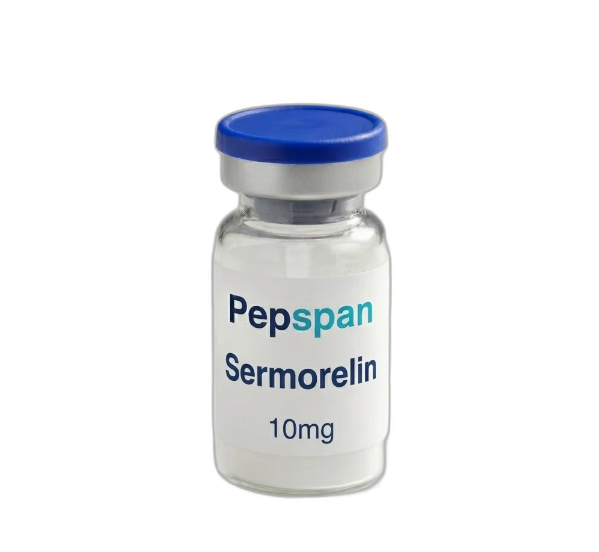
Sermorelin Peptide 10mg
10mg per vial — Lyophilized Powder
Description
Sermorelin at a glance. Sermorelin 10 mg, a lyophilised powder for laboratory research use, costs €49.90 at Pepspan. Independent analysis of the current lot, PEP-SERM-2608-01, by Janoshik Analytical is scheduled; the report will be published on the lot page. Ships from Europe with EU delivery in 2–5 days; free shipping on orders over €50. Pay by card, PayPal or crypto (−15%).
Sermorelin, also designated as GHRH(1-29)NH2, is a synthetic 29-amino-acid peptide that corresponds to the first 29 residues of the naturally occurring 44-amino-acid growth hormone-releasing hormone (GHRH) produced by the hypothalamus. This truncated analogue retains the full biological activity of endogenous GHRH, as research has established that the first 29 amino acids constitute the minimal sequence required for complete receptor binding and activation of the GHRH receptor (GHRH-R) on anterior pituitary somatotroph cells. Sermorelin is the most extensively studied growth hormone secretagogue in the research literature, with decades of published data spanning from receptor pharmacology to in vivo secretion dynamics.
The mechanism of action centers on the selective binding of Sermorelin to the GHRH receptor, a G-protein coupled receptor that activates adenylyl cyclase and elevates intracellular cAMP levels in pituitary somatotrophs. This cAMP-dependent signaling cascade triggers both the synthesis and the pulsatile release of growth hormone (GH) from secretory granules. A critical distinction between Sermorelin and exogenous GH administration is that Sermorelin preserves the physiological pulsatile pattern of GH secretion. In preclinical models, Sermorelin-stimulated GH release follows the natural ultradian rhythm, with amplified pulse peaks rather than the sustained supraphysiological elevation seen with direct GH injection. This pulsatile pattern is essential for maintaining GH receptor sensitivity and downstream IGF-1 signaling fidelity in experimental protocols.
Compared to full-length GHRH(1-44), Sermorelin offers practical advantages for research applications. The shorter peptide sequence is more cost-effective to synthesize, exhibits improved stability in solution, and demonstrates equivalent receptor affinity and efficacy in standardized bioassays. When compared to natural GHRH, Sermorelin shows comparable binding kinetics at the GHRH-R, with dissociation constants in the low nanomolar range documented across multiple receptor binding studies. The C-terminal amidation of the peptide further enhances its resistance to enzymatic degradation by carboxypeptidases, extending its functional half-life in experimental conditions.
Synergistic research protocols frequently combine Sermorelin with growth hormone-releasing peptides (GHRPs) such as Ipamorelin or GHRP-6, which act on the distinct ghrelin receptor (GHS-R1a). This dual-pathway stimulation produces significantly amplified GH pulse amplitudes compared to either class of secretagogue alone, a well-documented phenomenon in somatotropic axis research. Areas of active investigation include recovery and performance models examining GH-mediated tissue repair, body composition changes associated with sustained pulsatile GH elevation, and anti-aging research exploring the relationship between age-related GH decline and the responsiveness of the GHRH-GHRH-R axis to exogenous stimulation.
Sermorelin acetate is supplied as a white lyophilized powder with purity exceeding 98% as confirmed by HPLC analysis. Each vial contains 10mg of peptide and should be reconstituted with bacteriostatic water prior to use in research applications. The peptide sequence is Tyr-Ala-Asp-Ala-Ile-Phe-Thr-Asn-Ser-Tyr-Arg-Lys-Val-Leu-Gly-Gln-Leu-Ser-Ala-Arg-Lys-Leu-Leu-Gln-Asp-Ile-Met-Ser-Arg-NH2.
EU Shipping: Ships from the EU warehouse. Free shipping on orders over €50. No customs delays — intra-EU shipment. Tracked via Spring GDS / DHL EU Connect. Janoshik COA available per batch on request.
Reconstitution & Storage
Sermorelin 10mg is supplied lyophilised; in the laboratory it is reconstituted with bacteriostatic water (0.9% benzyl alcohol) under aseptic conditions — swirl gently, do not shake, since vigorous agitation can fragment the 29-residue peptide chain.
- Expected appearance: Clear, colorless solution with no particulates.
- Post-reconstitution stability: Store at 2-8°C protected from light. Use within 30 days; discard if solution becomes cloudy or develops particulates.
Stability & Half-Life Data
- Plasma half-life: Approximately 11-12 minutes following subcutaneous administration in rodent pharmacokinetic studies. Clearance occurs via rapid enzymatic degradation by dipeptidyl peptidase IV (DPP-IV) at the N-terminal Tyr-Ala bond and by serum endopeptidases.
- GH pulse profile: The short half-life produces a sharp, brief GH pulse 15-30 minutes post-injection, closely mimicking endogenous GHRH-mediated pulse dynamics — in contrast to long-acting GHRH analogs (CJC-1295 with DAC, ~8 day half-life) which produce continuous receptor activation.
- Lyophilized stability: Up to 24 months when stored at -20°C in a sealed vial protected from light and moisture. Up to 4 weeks at 2-8°C without measurable purity loss.
- Reconstituted stability: 30 days at 2-8°C in low-protein-binding polypropylene containers, protected from light. Beyond 30 days, oxidation of Met-27 and gradual N-terminal degradation may reduce biological activity.
- Thermal stability: Lyophilized form is stable up to 40°C for short transport excursions. Avoid sustained temperatures above 25°C.
- Freeze-thaw: Avoid repeated freeze-thaw cycles of reconstituted solution. Aliquot into single-use volumes before freezing if long-term storage is required.
- Incompatibilities: Avoid strong oxidizing agents — methionine-27 in the sequence is susceptible to oxidation to methionine sulfoxide, which reduces receptor affinity.
Composition
- Peptide: Sermorelin acetate (GHRH 1-29 NH2)
- Sequence: Tyr-Ala-Asp-Ala-Ile-Phe-Thr-Asn-Ser-Tyr-Arg-Lys-Val-Leu-Gly-Gln-Leu-Ser-Ala-Arg-Lys-Leu-Leu-Gln-Asp-Ile-Met-Ser-Arg-NH2
- Molecular Formula: C149H246N44O42S
- Molecular Weight: 3357.93 g/mol
- Purity: >98% (HPLC)
- Appearance: White to off-white lyophilized powder
- Quantity: 10mg per vial
Storage
- Store lyophilized peptide at -20C for long-term storage (up to 24 months).
- For short-term storage (up to 4 weeks), refrigerate at 2-8C.
- After reconstitution, store at 2-8C and use within 30 days.
- Avoid repeated freeze-thaw cycles.
- Protect from light and moisture at all times.
Certificate of Analysis
Every batch of Sermorelin sold by Pepspan undergoes rigorous third-party testing. Our Certificate of Analysis (COA) reports HPLC purity and the actual content per vial, measured by Janoshik Analytical on each lot. COA documentation is available upon request for any batch number. All testing is performed by independent European laboratories to ensure the highest standards of accuracy and reliability.
Batch Purity Report
Janoshik VerifiedCurrent batch: PEP-SERM-2608-01 · lot page →
Every batch of Sermorelin sold by Pepspan is independently tested by Janoshik Analytical (Prague, Czech Republic). HPLC purity and the actual content per vial are measured for each shipment. Reports are batch-specific — not generic.
View All Purity Reports →Research Disclaimer
All products on this website are sold strictly for research purposes only. Not intended for human or animal consumption. Must be handled by qualified professionals. Keep out of reach of children. By purchasing, you confirm you are a qualified researcher and will use these products solely for scientific research. Sermorelin is not approved for human or veterinary use by any regulatory agency. It must not be administered to humans or animals outside of approved clinical trials. Pepspan assumes no liability for any misuse of this product. All handling must comply with local regulations and institutional safety protocols.
Frequently Asked Questions
What is Sermorelin?
Sermorelin (GHRH 1-29 NH2) is a synthetic 29-amino-acid peptide corresponding to the first 29 residues of endogenous growth hormone-releasing hormone (GHRH). It is the minimal sequence required for full activation of the pituitary GHRH receptor and is the most extensively studied GHRH analog in the research literature, used to stimulate pulsatile, physiological GH release in animal models.
How is Sermorelin reconstituted?
Sermorelin 10mg is supplied lyophilised. In the laboratory it is reconstituted with bacteriostatic water under aseptic conditions — swirl gently, do not shake, since vigorous agitation can fragment the 29-residue chain. The solution should be clear and colorless.
What concentrations are cited in the research literature?
In rodent GHRH stimulation studies, Sermorelin has been investigated for its selective binding to the GHRH receptor and the resulting sharp, pulsatile growth-hormone release, which preserves the natural ultradian rhythm rather than producing sustained elevation. Researchers should consult primary literature (Walker, 2006; Sinha et al.) for study-specific protocols and concentrations.
How should Sermorelin be stored?
Store lyophilized Sermorelin at -20°C for up to 24 months. Short-term refrigeration at 2-8°C is acceptable for up to 4 weeks. After reconstitution, refrigerate at 2-8°C and use within 30 days. Aliquot into single-use volumes before freezing if long-term storage is required. Avoid repeated freeze-thaw cycles, which degrade Met-27 via oxidation.
Is Sermorelin legal in the EU?
Pepspan supplies Sermorelin exclusively as a reference material for laboratory research, not for human or veterinary use, and it is not an authorised medicine. Rules on buying and handling research compounds differ between countries and can change: check the rules that apply to you before ordering. Pepspan ships to all 27 EU countries from Spain.
What is the half-life of Sermorelin?
Sermorelin has a very short plasma half-life of approximately 11-12 minutes following subcutaneous administration. Clearance occurs via rapid enzymatic degradation by dipeptidyl peptidase IV (DPP-IV) at the N-terminus and by serum endopeptidases. This short half-life is why Sermorelin produces a sharp, pulsatile GH spike rather than the prolonged GH window seen with longer-acting GHRH analogs such as CJC-1295 with DAC.
Is a Certificate of Analysis available?
Yes. Every batch of Sermorelin is independently tested by Janoshik Analytical (Prague, Czech Republic). The Certificate of Analysis covers HPLC purity and the actual content per vial. COA is batch-specific and available on request.
What's the difference vs CJC-1295 + Ipamorelin?
Sermorelin is a pure GHRH(1-29) fragment with a ~12 min half-life, acting only on the GHRH receptor and producing sharp, brief GH pulses identical to endogenous GHRH signaling. CJC-1295 + Ipamorelin is a dual-mechanism blend that engages both the GHRH receptor (via the modified GRF 1-29 component) and the distinct GHS-R1a ghrelin receptor (via Ipamorelin), producing larger and more sustained GH pulses. Sermorelin is the cleaner research tool for studying GHRH receptor pharmacology in isolation.
Where can I buy Sermorelin online in Europe?
Sermorelin 10mg (lyophilized vial) is for sale online at Pepspan for €49.90, shipped from our stock in Spain. The independent analysis of the current lot PEP-SERM-2608-01 is scheduled at Janoshik Analytical (Prague): the sample goes to the laboratory in October 2026, and the lot page /l/SERM2608 will show the certificate as soon as it is issued. Orders leave Spain within 24–48 h with tracking; delivery in the EU usually takes 2–5 business days. Free EU shipping on orders over €50; GB, CH, NO, IS and LI ship at a flat €19.90; UK orders usually arrive 2–3 business days after dispatch (UPS, tracked). Pay by PayPal, bank transfer or crypto. Research use only.
Further Research Resources
Additional research articles, comparison guides, and laboratory protocols related to this peptide:
Related Products
 PREMIUM