 PREMIUM
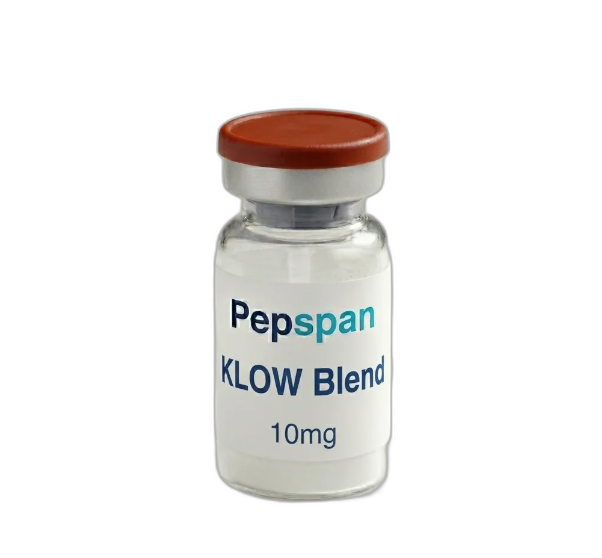
KLOW Blend Peptide
BPC-157 10 mg + TB-500 10 mg + GHK-Cu 50 mg + KPV 10 mg — Lyophilized Vial
Description
KLOW Blend at a glance. KLOW Blend (BPC-157 + TB-500 + GHK-Cu + KPV), a lyophilised powder for laboratory research use, costs €174.90 at Pepspan. Lot PEP-KLOW-2608-01: the BPC-157, TB-500 and GHK-Cu components have published Janoshik reports; the KPV analysis is scheduled and will appear on the lot page. Ships from Europe with EU delivery in 2–5 days; free shipping on orders over €50. Pay by card, PayPal or crypto (−15%).
The KLOW Blend is the most comprehensive recovery research stack available, combining four synergistic peptides in a single lyophilized vial: BPC-157, TB-500, GHK-Cu, and KPV. Each component targets a distinct molecular pathway involved in tissue repair, inflammation modulation, and cellular regeneration, creating a multi-vector research model that no single peptide can replicate. This premium formulation is designed for advanced research protocols requiring simultaneous investigation of complementary recovery mechanisms.
BPC-157 (Body Protection Compound-157) is a synthetic gastric pentadecapeptide that has demonstrated significant tissue repair activity across preclinical models. Its primary mechanisms include upregulation of vascular endothelial growth factor (VEGF) receptor expression, promotion of angiogenesis, and interaction with the nitric oxide system. Published research documents accelerated healing of tendons, ligaments, muscles, and gastrointestinal mucosa in rodent injury models. BPC-157 provides the foundational tissue repair component of the KLOW Blend, addressing vascular supply and structural tissue regeneration at the wound site level.
TB-500, a synthetic fragment of Thymosin Beta-4, operates through a fundamentally different mechanism centered on actin sequestration and regulation of cell migration. By binding to G-actin monomers, TB-500 promotes cytoskeletal reorganization that enables endothelial cells, keratinocytes, and other repair-associated cell types to migrate into damaged tissue. Its anti-inflammatory activity has been documented through downregulation of pro-inflammatory cytokines including IL-1beta and TNF-alpha. Where BPC-157 builds the vascular infrastructure for repair, TB-500 facilitates the cellular migration required to populate and reconstruct the damaged tissue architecture.
GHK-Cu (glycyl-L-histidyl-L-lysine copper complex) is a naturally occurring copper-binding tripeptide that acts as a potent signaling molecule for extracellular matrix remodeling. Research has identified over 4,000 genes whose expression is modulated by GHK-Cu, with particular relevance to collagen synthesis, decorin production, and stem cell recruitment. The copper ion is integral to the peptide's activity, serving as a cofactor for lysyl oxidase, the enzyme responsible for collagen and elastin cross-linking. GHK-Cu adds a matrix remodeling and regenerative signaling dimension that complements the direct tissue repair activities of BPC-157 and TB-500.
KPV is a C-terminal tripeptide fragment of alpha-melanocyte-stimulating hormone (alpha-MSH) consisting of the amino acid sequence Lys-Pro-Val. Despite its small size, KPV retains the potent anti-inflammatory and antimicrobial properties of the parent hormone while lacking its melanogenic effects. Research has demonstrated that KPV inhibits NF-kB nuclear translocation, a master regulator of inflammatory gene expression, and exhibits direct antimicrobial activity against several bacterial strains relevant to wound infection models. KPV provides the anti-inflammatory and antimicrobial layer of the KLOW Blend, addressing the immune and infection control aspects of the recovery environment.
The value proposition of the KLOW Blend is substantial: purchasing these four peptides individually would cost significantly more than the combined formulation, while the co-lyophilization ensures precise ratios and eliminates the variability inherent in manual reconstitution and mixing of separate vials. Each component exceeds 98% purity as verified by independent HPLC analysis. Reconstitute with bacteriostatic water prior to use in research applications.
EU Shipping: Ships from the EU warehouse. Free shipping on orders over €50. No customs delays — intra-EU shipment. Tracked via Spring GDS / DHL EU Connect. Janoshik COA available per batch on request.
Reconstitution & Storage
The KLOW Blend co-lyophilized vial is supplied for reconstitution with bacteriostatic water (0.9% benzyl alcohol); in the laboratory this is done under aseptic conditions — swirl gently, do not shake, since vigorous agitation can disrupt the GHK-Cu copper coordination chemistry and fragment the longer TB-500 chain.
- Expected appearance: Clear solution with a very pale blue tint from the GHK-Cu copper(II) complex. The pale color is normal and confirms intact GHK-Cu complex formation.
- Containers: Use copper-free, low-protein-binding polypropylene tubes for aliquoting. Avoid glass for long-term storage of working solutions.
- Post-reconstitution stability: Store at 2-8°C protected from light. Use within 14 days — the GHK-Cu component is the rate-limiting peptide for in-solution stability. Discard if solution turns brown or develops particulates.
Stability & Half-Life Data
- BPC-157 plasma half-life: Approximately 30 minutes following subcutaneous administration in rodent pharmacokinetic studies. Tissue effects (angiogenesis, VEGF signaling) persist much longer than the plasma window.
- TB-500 plasma half-life: Approximately 2-3 hours due to its larger molecular size (~4963 g/mol) and slower clearance.
- GHK-Cu plasma half-life: Approximately 30 minutes — rapid ligand exchange with serum proteins (albumin, ceruloplasmin) governs clearance kinetics.
- KPV plasma half-life: Approximately 10-15 minutes (small tripeptide). Intracellular anti-inflammatory effects via NF-kB inhibition outlast the plasma window.
- Lyophilized stability: Up to 24 months at -20°C in a sealed vial protected from light and moisture. Up to 4 weeks at 2-8°C without measurable purity loss for any component.
- Reconstituted stability: 14 days at 2-8°C in copper-free polypropylene containers, protected from light. The GHK-Cu component is the rate-limiting peptide — beyond 14 days, gradual loss of copper coordination affects blend integrity.
- Photodegradation: The GHK-Cu copper(II)-peptide complex is photosensitive. Always store and handle reconstituted blend in amber tubes or under low-light conditions.
- Freeze-thaw: Avoid repeated freeze-thaw cycles of reconstituted solution. Aliquot into single-use volumes before freezing if long-term storage is required.
- Incompatibilities: Avoid strong reducing agents, EDTA, and high-affinity copper chelators — they will strip the copper from the GHK-Cu component and disrupt blend activity.
Composition
- Component 1: BPC-157 (Body Protection Compound-157)
- BPC-157 Molecular Formula: C62H98N16O22
- BPC-157 Molecular Weight: 1419.53 g/mol
- Component 2: TB-500 (Thymosin Beta-4 Fragment)
- TB-500 Molecular Formula: C212H350N56O78S
- TB-500 Molecular Weight: 4963.44 g/mol
- Component 3: GHK-Cu (Copper Peptide)
- GHK-Cu Molecular Formula: C14H23N6O4Cu
- GHK-Cu Molecular Weight: 403.92 g/mol
- Component 4: KPV (Alpha-MSH Fragment)
- KPV Molecular Formula: C16H30N4O4
- KPV Molecular Weight: 342.43 g/mol
- Purity: >98% each component (HPLC)
- Appearance: White lyophilized powder
Storage
- Store lyophilized blend at -20C for long-term storage (up to 24 months).
- For short-term storage (up to 4 weeks), refrigerate at 2-8C.
- After reconstitution, store at 2-8C and use within 30 days.
- Avoid repeated freeze-thaw cycles.
- Protect from light and moisture at all times.
Certificate of Analysis
Every batch of KLOW Blend sold by Pepspan undergoes comprehensive multi-component third-party testing. Our Certificate of Analysis (COA) reports HPLC purity and the actual content per vial, measured by Janoshik Analytical on each lot. COA documentation is available upon request for any batch number. All testing is performed by independent European laboratories to ensure the highest standards of accuracy and reliability.
Batch Purity Report
Janoshik VerifiedCurrent batch: PEP-KLOW-2608-01 · lot page →
Every batch of KLOW Blend sold by Pepspan is independently tested by Janoshik Analytical (Prague, Czech Republic). HPLC purity and the actual content per vial are measured for each shipment. Reports are batch-specific — not generic.
View All Purity Reports →Research Disclaimer
All products on this website are sold strictly for research purposes only. Not intended for human or animal consumption. Must be handled by qualified professionals. Keep out of reach of children. By purchasing, you confirm you are a qualified researcher and will use these products solely for scientific research. The KLOW Blend is not approved for human or veterinary use by any regulatory agency. It must not be administered to humans or animals outside of approved clinical trials. Pepspan assumes no liability for any misuse of this product. All handling must comply with local regulations and institutional safety protocols.
Frequently Asked Questions
What is the KLOW Blend?
The KLOW Blend is a co-lyophilized 4-peptide research stack combining BPC-157, TB-500, GHK-Cu, and KPV in a single vial. Each component targets a distinct molecular pathway: BPC-157 (angiogenesis and VEGF signaling), TB-500 (actin sequestration and cell migration), GHK-Cu (extracellular matrix and gene expression), and KPV (NF-kB inhibition and antimicrobial activity). The blend is used in multi-vector tissue repair and recovery research models.
How is the KLOW Blend reconstituted?
The KLOW Blend vial is supplied lyophilised; in the laboratory it is reconstituted with bacteriostatic water under aseptic conditions — swirl gently, do not shake. The solution should be clear with a very pale blue tint due to the GHK-Cu copper complex.
What concentrations are cited in the research literature?
In rodent recovery studies, this four-component blend has been investigated for tissue repair, angiogenesis, and anti-inflammatory endpoints. Because the four components have different half-lives, the relevant experimental variable depends on which mechanism the study is targeting. Researchers should consult primary literature on each individual peptide (BPC-157, TB-500, GHK-Cu, KPV) for study-specific protocols and concentrations.
How should the KLOW Blend be stored?
Store lyophilized blend at -20°C for up to 24 months. Short-term refrigeration at 2-8°C is acceptable for up to 4 weeks. After reconstitution, refrigerate at 2-8°C protected from light and use within 14 days — the GHK-Cu component is the rate-limiting peptide for in-solution stability. Use copper-free polypropylene containers for aliquoting. Avoid repeated freeze-thaw cycles.
Is the KLOW Blend legal in the EU?
Pepspan supplies the KLOW Blend exclusively as a reference material for laboratory research, not for human or veterinary use, and it is not an authorised medicine. Rules on buying and handling research compounds differ between countries and can change: check the rules that apply to you before ordering. Pepspan ships to all 27 EU countries from Spain.
What are the half-lives of each component?
BPC-157 plasma half-life is approximately 30 minutes (subcutaneous) — though its tissue effects persist much longer. TB-500 has a longer half-life of approximately 2-3 hours due to its larger molecular size and slower clearance. GHK-Cu has a plasma half-life of approximately 30 minutes. KPV, as a small tripeptide, has a very short plasma half-life of approximately 10-15 minutes but exerts intracellular anti-inflammatory effects that outlast its plasma window.
Is a Certificate of Analysis available?
Yes. Every batch of KLOW Blend is independently tested by Janoshik Analytical (Prague, Czech Republic). The Certificate of Analysis covers HPLC purity and the actual content per vial. COA is batch-specific and available on request.
What's the difference vs Wolverine Blend?
The Wolverine Blend is a 2-peptide combination of BPC-157 + TB-500 focused on direct tissue repair (angiogenesis + cell migration). The KLOW Blend adds two additional layers: GHK-Cu for matrix remodeling and gene expression modulation, and KPV for anti-inflammatory and antimicrobial activity. KLOW is the more comprehensive research stack for studying multi-pathway recovery models; Wolverine is the cleaner research tool for isolated angiogenesis-plus-migration studies.
Where can I buy the KLOW blend online in Europe?
The KLOW blend (BPC-157 10 mg, TB-500 10 mg, GHK-Cu 50 mg and KPV 10 mg in one lyophilized vial) is for sale online at Pepspan for €174.90, shipped from our stock in Spain. Three of its four components were tested individually by Janoshik Analytical (Prague): BPC-157 99.7%, TB-500 98.45% and GHK-Cu 99.8% HPLC purity; the KPV analysis is scheduled for October 2026. Details on /l/KLOW2608. Orders leave Spain within 24–48 h with tracking; delivery in the EU usually takes 2–5 business days. Free EU shipping on orders over €50; GB, CH, NO, IS and LI ship at a flat €19.90; UK orders usually arrive 2–3 business days after dispatch (UPS, tracked). Pay by PayPal, bank transfer or crypto. Research use only.
Further Research Resources
Additional research articles, comparison guides, and laboratory protocols related to this peptide:
Related Products
 BEST VALUE